|
We are approaching
that long silly season — familiar for most of the year to the
inhabitants of these islands and called Winter — when many
motorists, in the use of their lights, behave inconsiderately toward
fellow road users and violate the provisions of the Highway Code.
Drivers misguidedly
think that illuminating their vehicles like Christmas trees gives
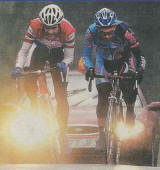
them extra safety; the reality is tragically different : dazzling
lights lead to crashes resulting in serious — often fatal — injuries
to vulnerable road users, particularly pedestrians, cyclists and
motor-cyclists.
The
Highway Code (para.114)
requires drivers "not use lights so
as to dazzle or otherwise discomfort other road users or use fog
lights otherwise than in seriously reduced
visibility", then switching them off when visibility improves
(it further stipulates that drivers should apply their
parking-brakes in stationary traffic, thereby extinguishing brake
lights and reducing glare for following drivers).
|
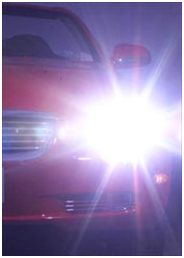
Headlight
Glare
 |
From February 2011 the law — originating from the EU
— will require that all new vehicles be equipped with
Daytime Running Lights (DRL) of a strength up to 1,200cd
(candela)
or dipped headlamps (800cd) which will include
high-brightness
LED
DRL and
Xenon High Intensity Discharge
(HID) headlights.
Prof.
Peter Heilig — an ophthalmologist at the Medical
University of Vienna — is a keen cyclist ;
His informative article
Safe Cycling
in Rundschau Polizei Sport,
magazine of the Austrian Polizei
sport Vereinigung (Police Sports Club) —
don’t fret, it has
been translated)
he clearly and simply describes how dazzling DRL and HID
vehicle lamps impinge upon the safety of cyclists.
Prof. Heilig's more detailed publication
Impaired Perception
graphically describes the tragic effect of blinding lights upon pedestrians and sportsmen.
It is
to be hoped that these publications will help us
persuade politicians that have previously voted for
dazzling DRL and HID lamps to reduce the intensity to
safe levels — it seems utter madness not just to permit
but actually to mandate 1,200cd lights beamed direct
into a driver’s eye — lights bright enough to rival
sunlight.
|
Pedestrians
A pedestrian
is equally vulnerable, even at a zebra crossing. In
Austria, it is called a "Schutzweg"
which means ‘protected way’. There is however increasing evidence
that drivers are failing to discern pedestrians at crossings, owing
to visual overload.
|
Other vulnerable
road users — motorcyclists
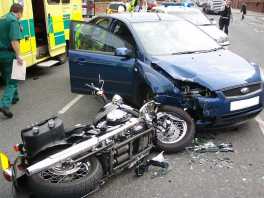
Motorcyclists’ safety is also compromised by DRL and
Xenon-HID lamps. From my own experience as a biker I can
say that many motorists (by which I mean those in
motor-cars) — despite the numerous exhortations in official
advertising to ‘think bike’ — are frequently unaware of a
motorcyclist approaching a junction and therefore emerge
right in his path. In daylight this is noticeably more
likely to happen when one is following a motor-car whose
lights are on: not really very surprising for the
headlights or DRL on the motor-car distract the attention of
the person waiting to emerge from the smaller and less
easily seen motorcycle behind. |
 |
Political actions and the scientific
background
EU directive
The EU uses reports
based on flawed methodology which predict a reduction of 6 -11% in
accidents; no EU country — not even
Sweden, where daytime running lights began — can demonstrate a
reduction in overall accidents due to DRL. Tragically, where the
effects of the introduction of DRL can be
measured, evidence gathered by DaDRL indicates that DRL
kill — particularly the most vulnerable
road users, as discussed above : Austria, deaths up 12%; Poland,
up 6%; Bulgaria, up 8%.
 |
Mike
Penning — Conservative M.P. for Hemel Hempstead and
Parliamentary Under-Secretary of State for Transport —
has
refused to take action and sides with the EU, claiming that
DRL will reduce UK accidents up to 6%. According to
statistics published by the Department for Transport,
reported casualties in 2009 reached
a long-term low of 222,146
in 2009. We are monitoring these figures
and have advised
Mr. Penning that we think he could be held legally liable if
they rise. (It is noticeable that, although the overall
figure for fatalities fell by 12%, the decline in fatalities
was smaller amongst cyclists (10%) and much smaller amongst
motorcyclists (4%).) |
Even the EU itself — the instigator of
the World’s most ambitious ‘carbon-reduction’ target — estimates
that the introduction of DRL will increase fuel consumption by 1.5%,
equivalent to emissions of 1.8million tonnes of CO2
p.a. in the UK. This is based on the assumption that 10% of
vehicles will use LED lamps (this is in line with our own
calculations). To put it in perspective : the Carbon Trust, with
an annual budget of £143million and around 500 consultants managed
to achieve a ‘reduction’ of only 1.8 - 2.0million tonnes of CO2
in 2009/10.
The position of DaDRL UK
|
The
unequivocal recommendation of Prof. Heilig is an
outright ban on DRL and HID lamps resulting in Austria
banning DRL.
After
tests conducting DRL in the
real world, Japan proposed
200cd - unlike laboratory tests undertaken by the EU,
which consisted of no more than showing slides to subjects of the experiment: a
procedure culminating in the adoption of 1,200cd!
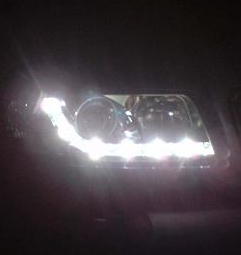
All HID headlights and most dedicated DRL — certainly
those fitted to the most recent German motor-cars (see
our letter to BMW) are,
when in use, in violation of
regulation 27
of the Road Vehicle Lighting Regulations, 1989
(item 11): they ‘cause undue
dazzle or discomfort to other persons using the road’,
particularly on uneven surfaces, where they need active
self levelling.
|
 |
|
Existing beam-self-levelling
mechanisms are designed merely to compensate for changes in
load distribution resulting from such things as rear-seat
passengers and luggage and therefore operate only at very
low speed, not reacting at all to undulations in the road
surface: speed humps, for example, and — thanks to
the government’s taking around £40-billion in road taxes but
spending only about 15% of that on the road network — the
marker of today’s British roads, the pot-hole. |
What
can you do ?
-
We have
wide cross-party political support. Please write to your MP and
get him to ask Philip Hammond Transport Minister to take action
— if Austria can defy the EU dictatorship and ban DRL so can the
United Kingdom.
Your MP can be found (sometimes) at
the House of Commons.
-
If you
have been involved in an accident or received a speeding ticket
and you think DRL/HID glare was a factor, the latest medical
evidence on the
Studies page
might help your legal team prepare its
case, particularly in relation to mitigating circumstances. See
also The Law.
-
Let’s
use the power of the Web to get action: forward this
Newsletter to everybody you think would be interested — perhaps
we can shame manufacturers and politicians in to action against
dazzling vehicle lights.
Kind regards,
If
the European Commission is really concerned with road safety,
why does it not mandate —
-
Advanced driving tests and regular re-tests?
-
Eyesight tests at three year intervals?
-
Headlights which do not cause glare and
dazzle at night?
Blinded Bi Xenon and Drivers
against Daytime Running Lights are worldwide voluntary groups of
experienced motorists including scientists, engineers,
mathematicians, lawyers and ophthalmologists supported by the
leading pedestrian, cycling and motorcycling organizations and
committed to improving road safety by reducing glare and other
distraction in the driving environment.
|
Ken’s comment — The Silly Season
Not only are we approaching the silly season with lights that dazzle and distract. Most users of DRL and HID lights do not understand the effect they are having on others.
Most drivers don’t know what bi-xenon means or even how to pronounce it, the ‘x’ usually being rendered as a ‘z’ (a clever ploy by the makers and the legislators ?).
After appearing on the BBC’s The One Show I received confirmation that xenon dazzle is not only dangerous but also little understood by those working at lower levels of the motor trade and industry.
The bureaucrats, the legislators and the manufacturers of both vehicles and vehicle components are aware of the dangers associated with xenon high-intensity-discharge lights ; yet they do nothing to prevent drivers from being dazzled to the extent that they fail to notice pedestrians, cyclists and other vulnerable road users.
An example
After a loyal customer bought a new Range Rover Sport, the salesman asked the him whether he had ever driven with bi-xenon lights. “No,” replied the customer. “Be careful,” he was told. “Because your new lights are so bright other drivers will flash you.” This warning was followed by, “Don’t worry — your vehicle passes all government tests.”
I knew then, without doubt, that the bi-xenon HID lighting system is dangerous. This realization — by me and others — lay behind the founding of Blinded Bi Xenon; we shall not rest until both manufacturers and government are persuaded to modify these designs radically ; moreover we shall ensure both are held to account for putting the lives of us all in danger.