|
Some
cyclists simply hate drivers and want nothing to do with them, but
sometimes motorists and motorcyclists are also keen cyclists and probably
vice versa, the key being to share road space in harmony and safety.
Cyclists tend to keen environmentalists, the consequences of world
wide CO2 and diesel pollution from DRL are a factor.
|
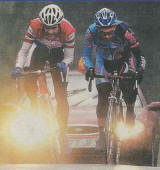
But the real concern to a cyclist, is loss of conspicuity caused by
DRL and Xenon-HID lights
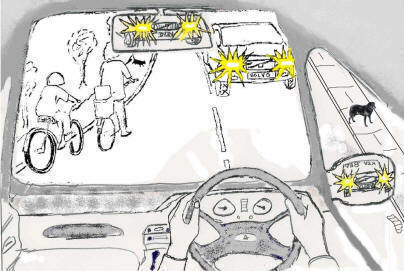
As a driver, if
your concentration is distracted by someone cocooned in an airbag
padded metal box with lights ablaze appearing just as you are about
to pass a cyclist, it reduces a driver's ability to perceive the
hazard correctly.
A driver's natural tendency is to shy away from the other
car with potential disastrous results for the cyclist who should be
given a clearance of at least 2 metres.
Hypothetical maybe, but if your eyesight is de-sensitised
after a day of driving against other vehicles with
headlights ablaze , it puts cyclists at
an unnecessary risk - see comments from the USA trucker -
What's New Also see
a
cyclist's submission to the EU DRL consultation.
See
Safe Cycling
by
University Professor Peter Heilig
|
 |
Vulnerability and Risk Emergence in
Complex Traffic Scenarios by
University Professor Peter Heilig:
Disturbance of the equilibrium of the
smooth flow in complex traffic scenarios can be compared with
some rather thoughtless human eco-system-interactions in the
past. Minor changes may provoke catastrophes and sequences of
undesired irreversible failures ('global dimming', climate
change, etc.).
'Natural' brightness distribution within
visual fields being just one of some prerequisites for the
driver's optimized sight, attention and perception. Any
accentuation or 'over'-accentuation of stimuli would cause
unequal distribution of attention. Consequently some
'accentuated' traffic-relevant objects' Daytime Running Lights
(DRL) catching more attention than the less conspicuous objects
or 'weaker' traffic participants are creating interference
factors thereby disturbing a delicately balanced vulnerable
stability. The occurrence of traffic-accidents is probably not
reflecting the true potential of induced hazard. 'Near misses'
and the avoidance of crashes by preventive driver-reactions just
in time may falsify the attempts of expert-evaluations and
analysis.
The signalling effect of DRL functioning as
distracter is only one factor causing imbalance and a kind of
non-equilibrium. Side impact- and rear end crashes are
indicating the effect of 'imbalance of attention' by
accentuating the front of vehicles exclusively (in some
countries).
All past
attempts to increase the conspicuity of pedestrians and cyclists
have failed
Reflecting materials appear to be
ineffective in connection with DRL. The illumination of
bicycles suffers from systematic misconception: With decreasing
daylight intensity, front and rear vehicle lights attract the
attention of other traffic participants; however cyclists are
hard to observe and to detect against a darkening background.
The average bicycle illumination does not protect at all
against the risk of (fatal) side impacts.
Deaths in mixed traffic are avoidable:
blinding glare caused by the bluish High Intensity Discharge
(HID) headlights can be observed with increasing frequency since
the introduction of the experiment (Licht am Tag) in Austria.
Additionally headlight misalignment and road undulations cause
momentary dazzle.
Usually more factors than one are
multiplied before the catastrophe of a traffic accident:
sometimes a harmless (probably superfluous) traffic sign could
be just one distraction too much and provokes cognition failures
(overload of the visual short term memory).
The Times 05 November 2010
The number of road deaths in April-June
fell to 470, down by 16 per cent from the same period last year,
provisional figures from the Department of Transport showed. The
number of road users killed or seriously injured was also down,
by 6 per cent to 6,620. Casualty rates
fell for all types of road user except cyclists: the number
killed or seriously injured rose by 5 per cent to 850.
The Times 30 June 2006
"Cycling
was the only mode of transport with an increase in deaths in 2005 up
10% to 148 from 134 in 2004." Ben Webster Transport
Correspondent
The Sunday Times 27
February 2006
"In 2004, the
latest year for which figures are available, 134 cyclists were
killed on Britain’s roads, a rise of 18% on the previous year."
More cyclists
die on roads
Arthur Leathley
Transport Correspondent The Times
A SHARP rise in
the number of cyclists and motorcyclists killed in road crashes
overshadowed a general fall in casualties last year. The growing
popularity of two-wheeled travel threatens to disrupt government
plans for reducing fatalities and serious injuries. The number of
cyclists and motorcyclists killed rose by about 10 per cent,
although the overall road death toll remained stable. Ministers said
that the number of deaths was less than might have been predicted by
the in numbers riding. Road safety campaigners maintained however,
that unless measures were taken to offer more protection to
cyclists, the death toll would rise. The Government has set a target
of reducing deaths and serious injuries by 40 per cent by 2010.
Although
British roads are among the safest in Europe, 45 per cent of
accidental child deaths occurred on roads, for teenagers aged 15 and
19 the proportion is 72 percent.
|